Posted on May 10, 2026
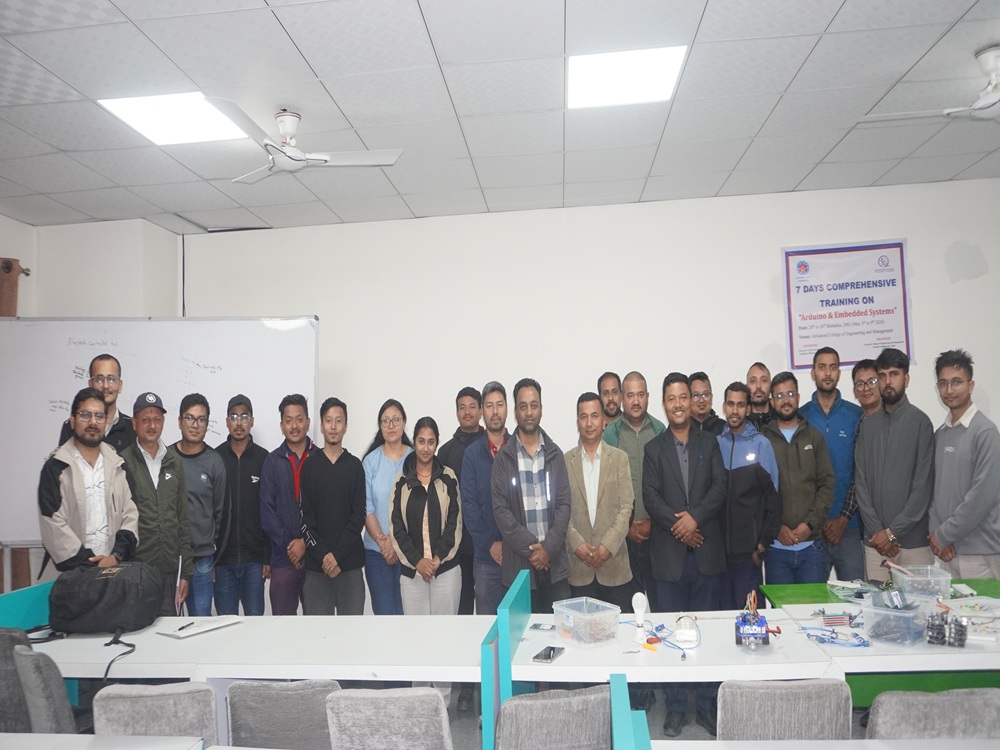
Advanced College of Engineering and Management (ACEM) successfully conducted a 7-Day Hands-on Training on Arduino and Embedded Systems from Baishakh 20 to 26, 2083, under the grant support of the University Grants Commission (UGC), Nepal. The practical-oriented training program was organized with the objective of providing participants with both theoretical understanding and hands-on experience in Arduino programming and embedded system development.
The training brought together participants from ACEM as well as various engineering, IT, and technical colleges, creating an interactive learning environment for students and enthusiasts from diverse technical backgrounds including Computer, Electronics, Electrical, and Information Technology.
The program commenced with an inaugural session on Baishakh 20, 2083, marking the beginning of an engaging week focused on experiential learning and technical skill enhancement. Throughout the seven days, participants actively engaged in practical sessions designed to strengthen their understanding of embedded systems and real-world applications.
The training sessions covered a wide range of topics including Arduino fundamentals, LED interfacing, introduction to sensors, LCD (I2C) interfacing, ultrasonic sensors, BO motor and Servo motor interfacing, speed control using PWM, Bluetooth (HC-05) module interfacing, and the basics of MIT App Inventor. Each session combined conceptual learning with practical implementation, enabling participants to develop hands-on experience in electronics and embedded system applications.
The program emphasized project-based and application-oriented learning, encouraging participants to explore innovation, problem-solving, and real-time system development. Through continuous interaction, experimentation, and guided practical exercises, participants gained valuable exposure to modern embedded technologies and their applications in automation and smart systems.
The training concluded on Baishakh 26, 2083, with certificate distribution, concluding remarks, and an interactive feedback session. Participants shared their learning experiences and reflections on the program, highlighting the effectiveness of the hands-on approach and the relevance of the training in enhancing technical competencies.
The successful completion of the program reflects ACEM’s continued commitment to promoting practical engineering education, innovation, and industry-relevant skill development through technical training, research, and experiential learning initiatives.