Posted on July 08, 2026
The "Monkey Control and Damage Mitigation R&D Project" is an active interdisciplinary research project being pursued and coordinated by CAILIC at ACEM, engaging other in-house centers and departments within ACEM (including Research and Innovation Unit- RIU, the AI Research Center, and the Electronics and Computer Engineering Department, among others), as well as external partners from both academia and industry.
The project, entitled "Randomization of Multi-modal Repellents in Controlling Monkey Riot and Farm Damage Mitigation in Nepali Villages," offers an innovative, intelligent, and practically workable solution to combat the existing problem of monkey-induced farming damage in Nepali villages. It is also applicable to similar issues in manufacturing industries located near forests, such as the Balaju Industrial Area, and may also be useful in detecting and controlling other wild animals.
The problem of monkey attacks, as part of the increasing Human-Wildlife Conflict (HWC), has consistently been faced by farmers across Nepal—from Taplejung in the east to Baitadi in the west—leading to the unfortunate forced migration of local communities from their respective villages. This issue has been widely discussed in the mainstream media, Parliament, parliamentary committees, the PMO, ministries, and other concerned authorities and professional cohorts. It has also been one of the top political agendas in recent elections. Indeed, some local governments have allocated budgets to mitigate the reported damage and loss. However, the challenge of monkey attacks on farms—which can be regarded as a form of disaster, contributing to village migration and the loss of agricultural productivity—unfortunately remains unresolved.
The Government of Nepal (GoN), led by Rt. Hon. Balendra Shah, has lately formed a multi-stakeholder and special task force for HWC, seemingly with a focus on monkey-associated damage mitigation and HWC-resilient communities, with the Ministry of Agriculture, Forestry and Environment and the National Trust for Nature Conservation (NTNC) taking the lead and calling for broader collaboration.
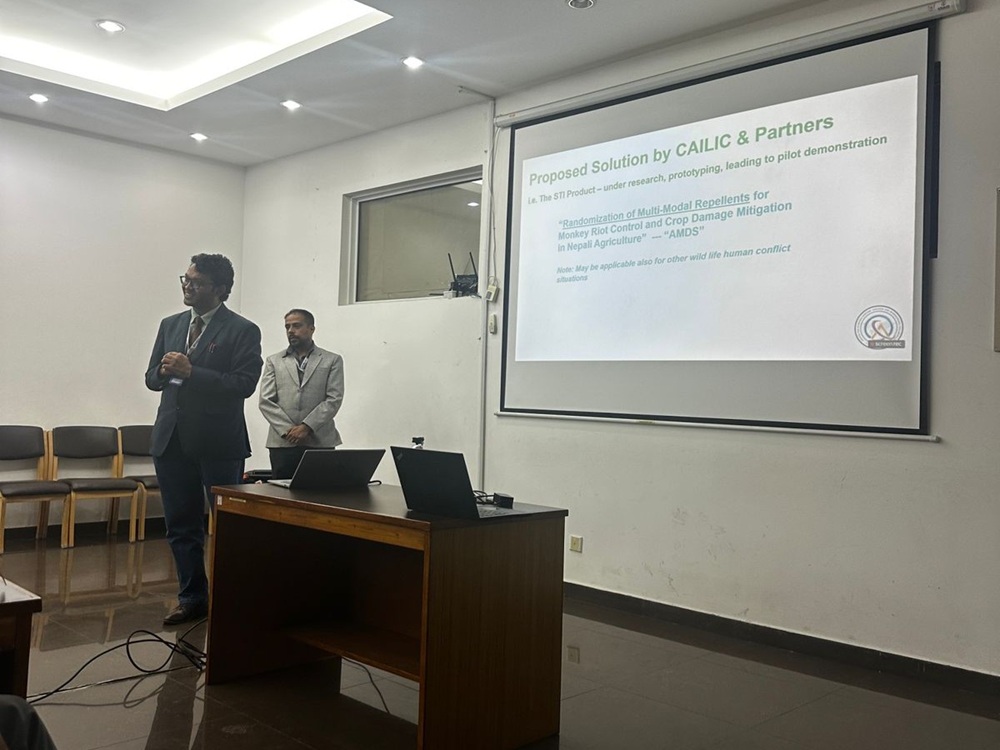
On Monday, 6 July 2026, the CALIC, ACEM team were invited by the task force to deliver a presentation at the NTNC Seminar Hall in Khumaltar on our ongoing research. The presentation featured our original idea of a sustainable multi-modal solution simulation (both ground-based and aerial), backed by an extensive literature review and encompassing the proven interdisciplinary expertise within our team, followed by element-level prototyping currently in progress.
The presentation was jointly delivered by Associate Professor Dr. Shanker Dhakal (CAILIC Chief and Structural Engineering/DRM Specialist) and Assistant Professor Dr. Binayak Ojha (Sensor/IoT/ICT Specialist) from the RIU and Electronics and Computer Engineering Department of ACEM, with assistance from the project's Research Engineer, Mr. Biplav Giri. Other team members, Mr. Prakash Gyawali (academic collaborator from LBU), overseeing the solar and green energy aspects of the project, and Mr. Khum Bdr. Kunwar (former EME and Biomedical Chief at Nepal Army), overseeing the holistic ecosystem and buffer zone management aspects of the project, were also present.
We sincerely appreciate the contributions of other expert team members, including Dr. Raksha Dangol from the Electronics and Computer Engineering Department, Dr. Bipun Man Pati, from the AI Research Center of ACEM, and the inputs received from several Research Assitants and staff at RIU Mr. Aryan Kafle and Ms. Silsila Poudel and the Drop project Mr. Abhishek Kumar Shah and Mr. Sobhit Khatri. We also acknowledge the support of Mr. Bharosh Yadav (Assistant Professor of Mechanical Engineering at IOE, ERC), Mr. Anil Pokhrel (Former HWC Consultant for NTNC), and Mr. Gobinda Pokhrel (Information Officer/Conservation Advocate at NTNC) for their valuable input and collaboration.
During the meeting, we presented a detailed proposal consisting of a timeline and budget for potential government funding. If properly funded, we will be able to fully develop our full-scale prototype and pilot it within a few months.
We extend our sincere thanks to Hon. MP Sagar Dhakal and Mr. Madan Paudel (Task Force Member) for connecting us to the task force, and to Mr. Ashok Subedi (Member Secretary) and Mr. Hom Chhetri (Chair) of the task force for listening to our presentation with keen interest, as well as for their appreciation, encouragement, collaborative and supportive gesture, and valuable comments. It was rewarding to have many fellow HWC researchers, including those from the central departments of Tribhuvan University, Kirtipur, and other private and NGO sectors, present during the meeting.
In passing, we would also like to acknowledge our earlier meeting with Dr. Ojaswee Sherchand, Chair of the Parliament Committee on Education, Health and Information Technology, whose encouragement inspired us to pursue focused research on agricultural and educational sector transformation at CAILIC as one of the new government's priorities. Thanks are also due to Prof. Dr. Sudan Jha at NPC for his constant encouragement and to Mr. Ram Rimal of RamLaxman Innovations for the early discussions and potential future collaboration. We wholeheartedly appreciate the heartwarming support of the Chairperson of ACEM, Mr. Ramesh Kumar Silwal, and the academic leadership—Principal Prof. Dr. Durga Prasad Sangroula and Vice Principal Assoc. Prof. Laxmi Bhakta Maharjan—for several ongoing R&D projects, including monkey damage mitigation through CAILIC.
Lastly, we sincerely hope that the new STI ministry, led by the NIC Chairperson and Hon. MP Mahabir Pun, will provide the necessary liaison support for merit-based and rapid funding (based on his own past advocacies and social media hype) for the most topical and pressing R&D projects, such as "Monkey Riot Control and Damage Mitigation," "Post-Jajarkot Reconstruction and Relocation Housing Using Vernacular Architecture and GSI Technologies," "Next Generation Dam Safety by Incorporating Landslide-Reservoir Interactions," and "AI School for Local Inclusivity and Global Employability," among others. These projects are being pursued with passion and dedication by the researchers at CAILIC and its partners, and we believe they not only address existing gaps in government programmes and industry practices but also contribute to scholarly publications and the overall scientific ranking of Nepal.
Let us transform the current state of Nepali academia and industry, where researchers, innovators, and private institutions are often compelled to conduct research projects for societal benefit and scientific advancement by investing from their own pockets. This is simply not encouraging.
Click here to read the full news coverage.
Please click here to take a glimpse of the presentation.